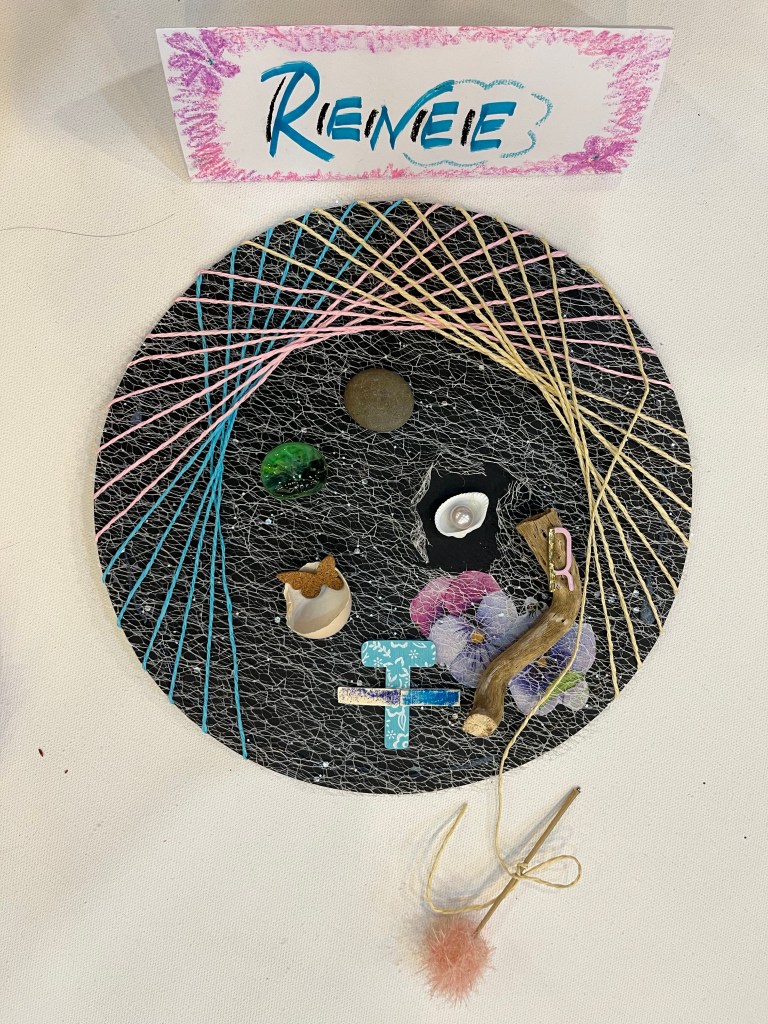
My mandela resembles the image of a native American dream catcher, which is a protective charm used to help assure good dreams to those who sleep under them. I did not intend to create it, but simply using some threads to make curve with lines to imply that I am a flexible person yet I also act on principles (i.e., 外圓內方). I left the dream catcher unfinished by connecting it with a fake dandelion. I remember I had written a poem in my high school titled “Dandelion” and it ended with a sentence stating “Sadly that it is dreamless” (i.e., 恨已是無夢). It has been almost 30 years from the time I wrote this poem, but this time I gave the dandelion a new meaning–the hope to continue chasing my dream.
Jung (1960) talked about the concept of “synchronicity” to describe somethings happen seemingly coincidental yet meaningful that is not about causality. He defined synchronicity as an … …
“acausal connecting principle,” “meaningful coincidence”, “acausal parallelism” or “meaningful coincidence of two or more events where something other than the probability of chance is involved.” (p.44)..”
(Jung, 1960)
It highlights an important element of subjective meaningfulness, which I think it is very important in art making process.
Dandelion – Symbol of Hope and Dream
While I was creating my mandela, I occasionally located a fake Dandelion on the work bench. It looked as if it was a wonderful final touch for my mandela – a symbol of hope and dream. Dandelions bloom in early spring with their golden flowers, it represents the return of growth and life after a harsh winter with a display of strength. The outburst of deep yellow flower heads of the Dandelion in the grass field always give out a sense of happiness and brightness. Days after flower, it goes to seed and forms feathery puffballs. For generations, we were told that if we wish for something while blowing, and manage to blow all of the seeds away, then the wish will come true. For me, the process of blowing the seeds of a dandelion and its symbolic meaning could be more substantial, it serves as a symbol of survival, reborn and rebellion. Dandelion is like a beautiful fighter that refuses to stay hopeless, and it also introduces randomness to those socially accepted regulations and routines of my everyday life.
My synchronicity with the dandelion aids in awakening my need for getting in touch with my inner self and being a more autonomous grown up (as compared with the me in high school), that is to find my path of individuation in Jung’s words. A watercolorist, Charles E. Burchfield, had elevated the dandelion to the spiritual realm in his paintings. He had a caption for his dandelion paintings “does profusion breed Confusion? I think rather it is like the prolific quality of Nature, who scatters seed in such great quantities” (Burchfield, 1916). Does profusion breed confusion? This is really a good question to reflect on our surroundings and lifestyle, and it seems I have more than I need. I tend to be overly function with a tendency striving for perfectionism. However, the irony truth is that I feel inadequate deep in my heart. The more I strive for perfection, the more I feel unrest with myself. By amplifying the characteristics of a dandelion, it allows me to see my need for a more autonomous version of myself by being a little bit more like a wild flower with its freely bloom, even it may make gardeners hectic. Ultimately, I would love to see the scattering seeds grounded for rooting and budding. I am looking for this piece of land for grounding and the simplicity that eases my confusion.

 Bouquet de Lifescape